I was eleven when my aunt brought a VHS copy of Spirited Away back from a trip to Tokyo, and we watched it on a Sunday afternoon in my grandmother’s apartment in Genova with the curtains half-closed against the August sun. I did not understand most of it. I did not need to. What I remember, with the precision of a still frame, is the moment Chihiro sits beside Haku on the steps of the boiler room and eats an onigiri while crying, and the orchestra goes quiet, and the camera does nothing — it just watches her chew. That afternoon decided, in a way I would only articulate years later at the design school on Via Durando, that I was going to spend my working life trying to make images that breathed like that. Today I run a small graphic design studio off Via Tortona here in Milan, and Hayao Miyazaki’s frame composition paired with Joe Hisaishi’s piano remains, twenty-five years on, one of the core influences I cannot work without.
I am writing this post because the lofi visual canon — the rainy windows, the autumn villages, the lantern-lit nights, the cat asleep on the desk — is essentially a remix of a very specific subset of Studio Ghibli’s output, and I think the lineage is worth tracing properly. Every recurring lofi visual element runs back to a Ghibli film, often to a particular shot, and once you see the genealogy it becomes much easier to use these images on purpose rather than by reflex.
Why Ghibli specifically
Ghibli matters for lofi because most of their films are about the moments between events. Disney drives plot through action; Ghibli pauses. The characters do laundry, take baths, eat slowly, sit alone, walk through a field, look out of a window. These quiet scenes were never filler. They were the entire point. Miyazaki and Isao Takahata built their films around small contemplative beats because that was the storytelling tradition they had inherited — Japanese cinema after Ozu, manga at its most patient, Heidi and the European children’s literature Takahata adapted in the seventies. I once spent a whole evening with a printout of My Neighbor Totoro stills laid across the studio floor trying to convince a hospitality client that an entire brand identity could be built around what happens to light when it falls through a paper screen, and the only argument that finally landed was showing them how long Miyazaki holds the shot.
Lofi music wants to soundtrack exactly those beats. Patient, calm, no narrative arc demanded. The compatibility was preexisting; the genre simply had to discover the visual archive already waiting for it.
My Neighbor Totoro (1988): the rural countryside template
Before Totoro, foreign audiences mostly associated Japan with Tokyo neon, samurai, or the bullet train. Totoro showed something else — a soft, green, agricultural Japan full of rice paddies and wooden houses and August afternoons that seem to last for days. What lofi inherited from this film, and from Only Yesterday a few years later, is essentially an entire grammar of countryside. The skies are slightly imperfect, with visible brushwork and gentle gradients, never the flat blue of a digital render; I keep a small swatch book in the studio with five hand-mixed gouache “Totoro skies” that I use as a north star whenever a junior designer hands me a sky that feels like a Photoshop fill. The architecture is wooden, with tatami rooms, sliding shoji, and the engawa porch the family keeps drifting back to. Weather is treated as a character — wind moving through trees, summer heat haze rippling off the road, the sudden thunderstorm Mei and Satsuki shelter from. The palette stays in warm earths, muted greens and soft yellows.
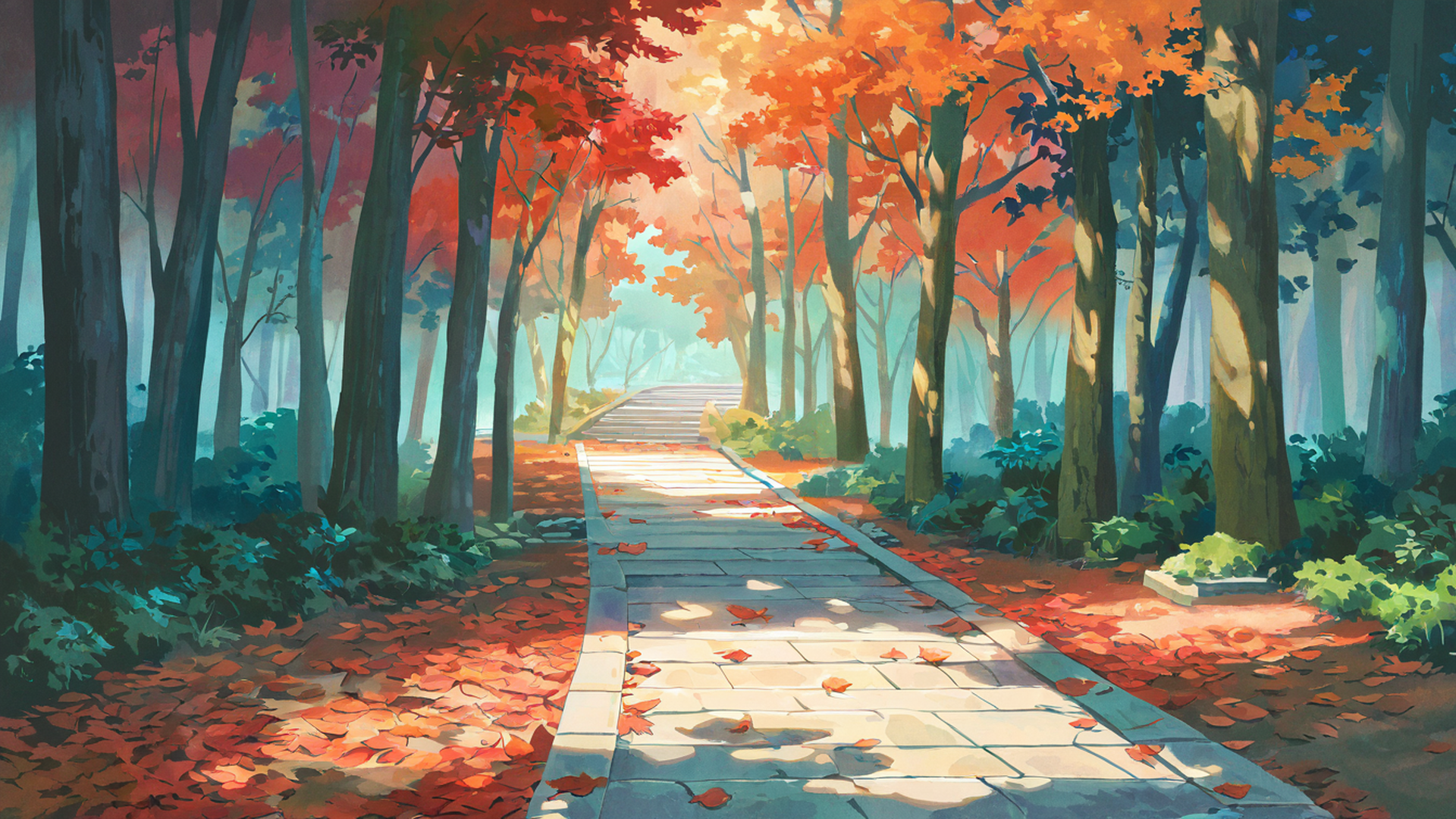
Modern lofi gallery scenes labelled “rural Japanese countryside” or “summer rice fields” pull directly from this vocabulary; you can see the direct lineage in our rice fields summer gallery and the autumn maple village set. I sometimes use a single frame from the bus-stop sequence when a client asks for “warmth without being saccharine”; it answers the brief by itself.
Whisper of the Heart (1995): the studying-girl template
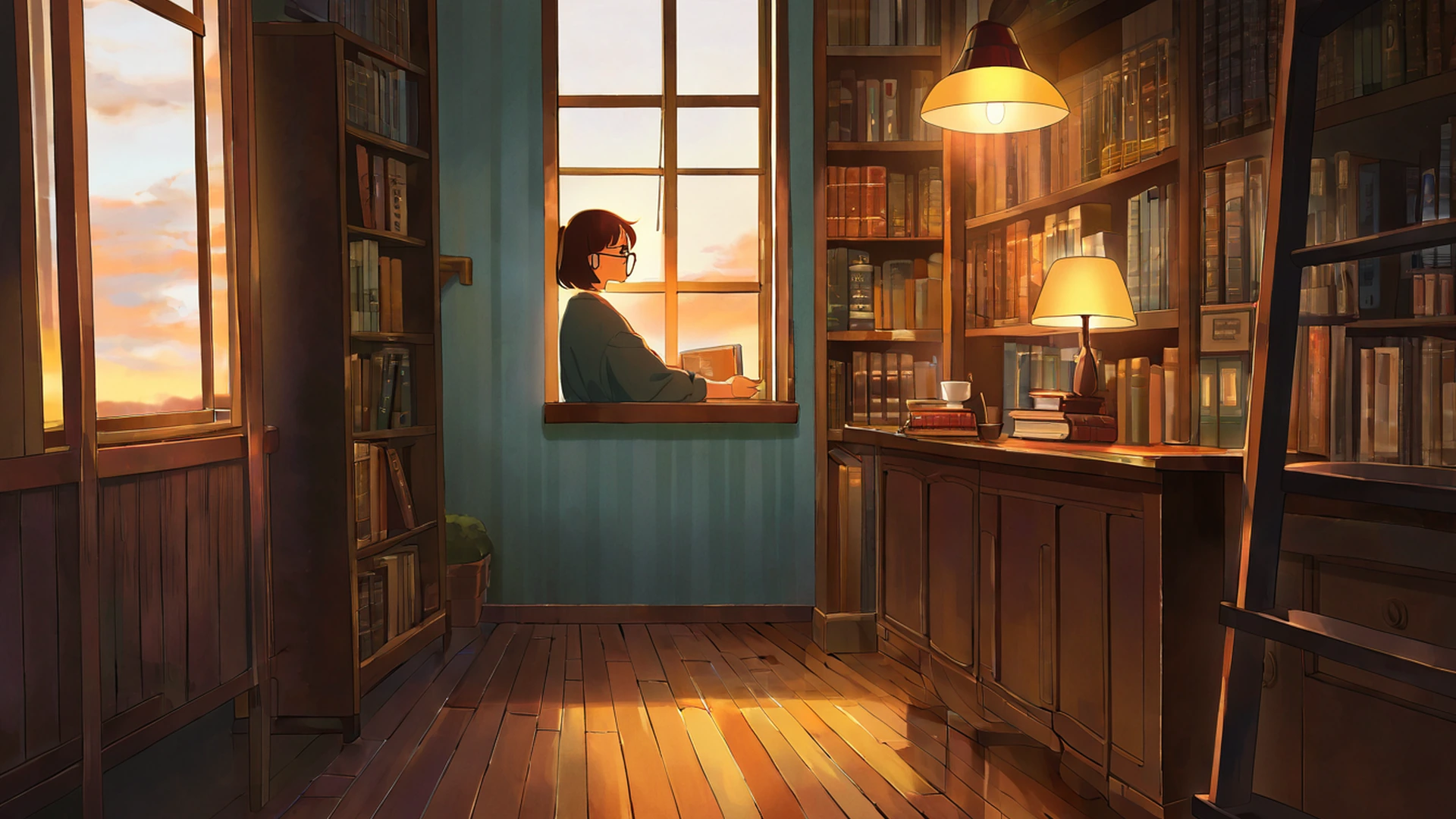
If lofi has one canonical visual ancestor — one frame from which an entire aesthetic descends — it is the desk scene from Whisper of the Heart. The film follows Shizuku, a teenage girl who reads and daydreams and writes at the desk by her bedroom window, with the lights of west Tokyo glittering beyond the glass. That single composition, the warm interior facing a cooler exterior, the girl absorbed in her own work, the cat in the periphery, the books stacked on the desk — that is Lofi Girl. The visual was lifted almost intact, and you can read more about the inheritance in our Lofi Girl origin post.
What I have stolen from this film, repeatedly, is the use of the window as a portal. I once analysed la luce of the opening minutes shot by shot for a palette pitch to a Milanese stationery brand who wanted their packaging to feel like “the quiet hour before homework.” We landed on five values — a warm desk-lamp amber, two cool exterior greys, a paper white, and one accent in the green of Shizuku’s school uniform — and the deck I built around those values won the account. The other thing Whisper of the Heart teaches you, if you are paying attention, is that the activity in the frame matters. Shizuku is not simply sitting; she is writing, with a pencil, with intent. The girl-at-desk image works for studying because she is studying too. Lofi illustrations that get this wrong — the girl staring vacantly at her phone, the desk with no work on it — break the spell almost immediately.
Spirited Away (2001): the night festival template
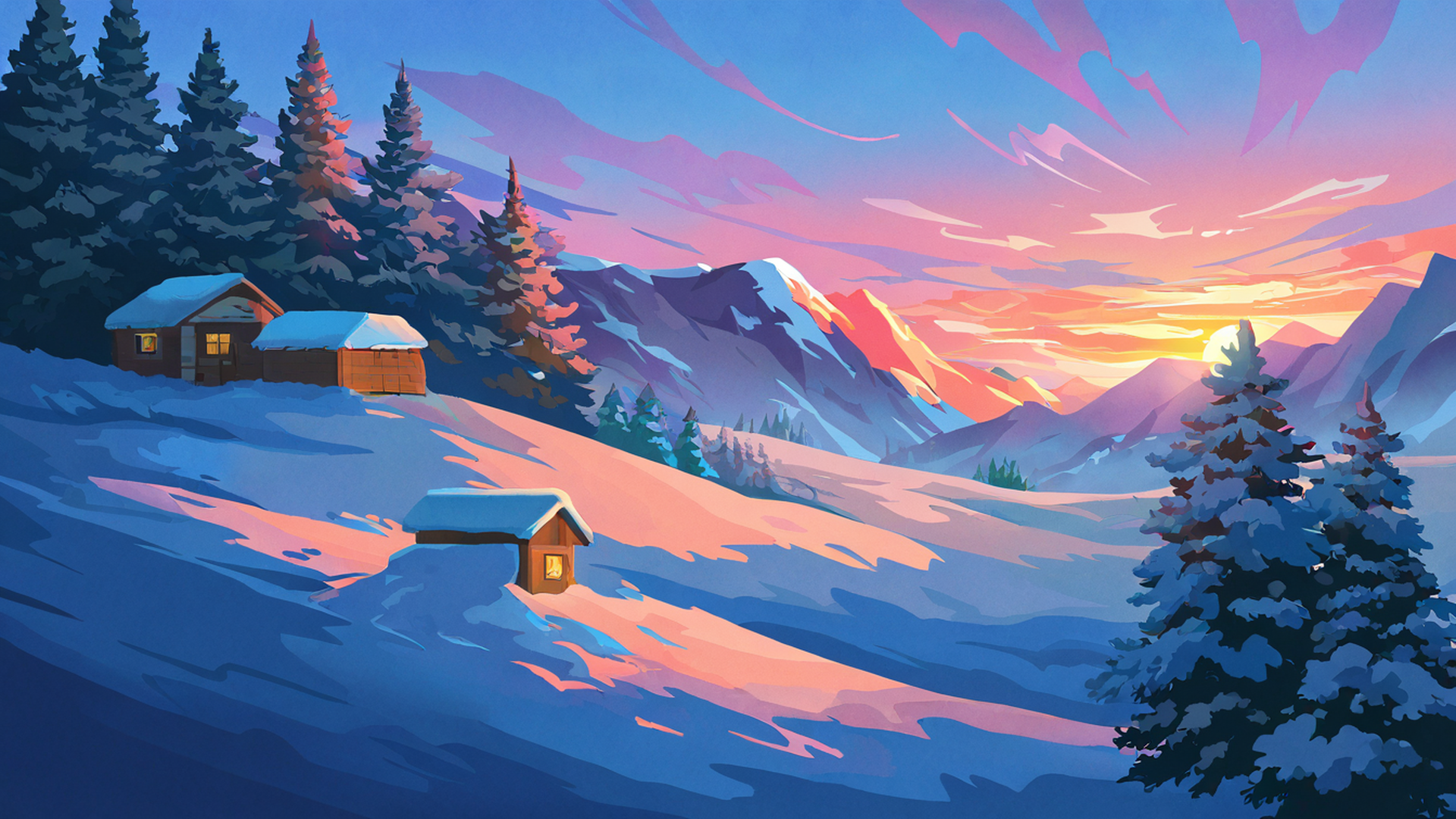
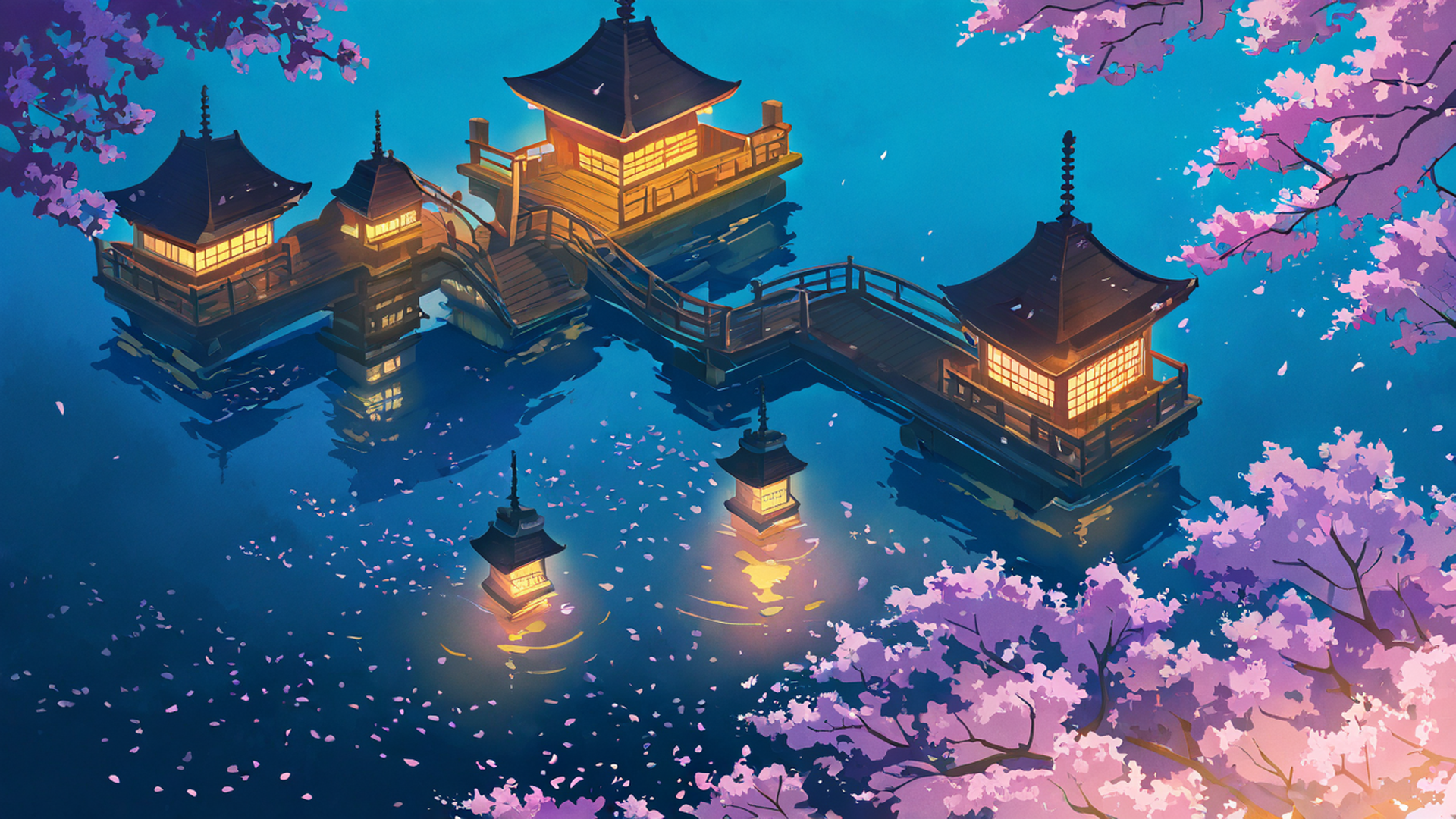
The lantern-lit bathhouse, the night market, the river of spirits drifting past Chihiro as she leans on the railing, the unending food preparation in the kitchens — Spirited Away gave lofi an entire second register beyond the daytime countryside one. This is the night-market sub-aesthetic: strings of paper lanterns, glowing windows, smoke from food stalls, warm interiors held against dark exteriors. Our lantern festival night gallery is essentially a long sustained homage to the first arrival at the bathhouse. The onsen warmth — steam rising past wooden beams, soft lighting, the slow rituals of bathing — recurs in our winter onsen set, and food preparation as a quiet ritual, hands kneading dough or a broth simmering for hours, became the entire “cooking lofi” micro-genre that I see drifting past on TikTok at midnight.
What I find most useful in Spirited Away, as a designer, is how the spirits are handled. They are mostly silent observers; the film does not chase them, they pass through frame and the world continues. I steal this constantly — for a recent project, a small literary press in Brera, I built a series of book covers in which a single shadowy figure was always slightly off-centre, never the subject. The client called it haunted. I called it Ghibli.
Kiki’s Delivery Service (1989): the cozy-bookshop template
Smaller in scope than the others, but vital for the indoor-cozy subset of lofi visuals. Kiki settles into a small bakery in a Mediterranean-coded coastal town that Miyazaki built out of bits of Stockholm and the south of France, and the interiors of that bakery are the genetic ancestor of every “café morning” lofi loop I have ever seen. Bread shelves stacked at slightly random heights, the oven throwing warmth into the room, customers coming and going through a small bell-hung door — our coffee shop morning gallery inherits this directly. Kiki’s small upstairs room, with its window and a few books and the cat Jiji on the bed, is the prototype of every reading-nook illustration in the canon.
The light in Kiki’s Delivery Service is cooler and more European than in the rural Japanese films, which is one reason that, working in Milan, I lean on it more than on Totoro for client work. When an Italian client asks for “warmth,” they almost always mean Kiki’s bakery rather than a Saitama summer; the Mediterranean palette of clay tile, dusty blue shutters and powdered-sugar white speaks to them in a way that the deep paddy-green of central Japan does not.
5 Centimeters Per Second (2007): the Makoto Shinkai detour
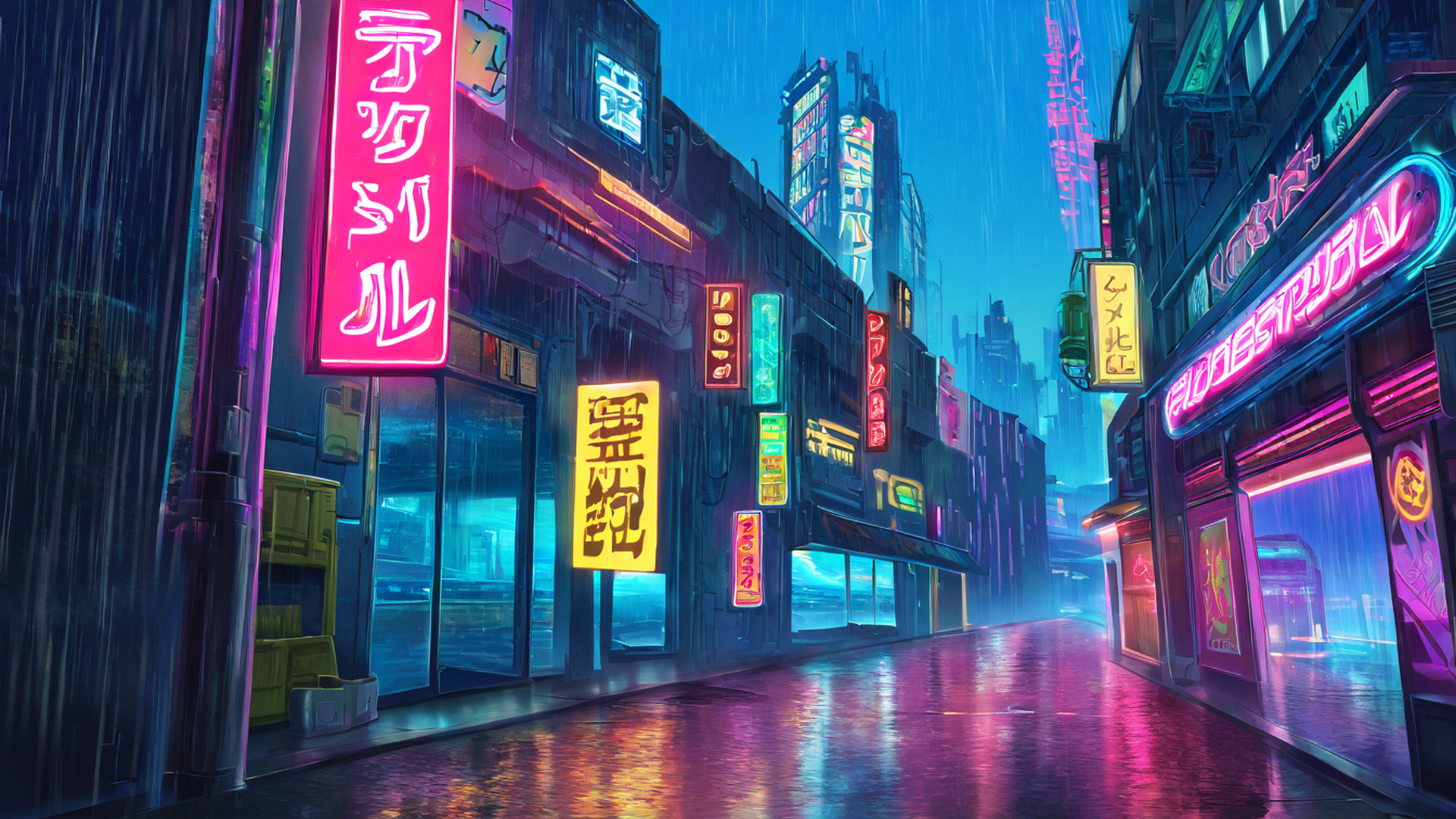
Not Ghibli proper — Makoto Shinkai works out of CoMix Wave, not Ghibli — but the same Japanese animation tradition and increasingly the same audience. 5 Centimeters Per Second established the rainy-night-Tokyo register that now dominates a huge swathe of lofi visuals. Rain beaded on glass, lit from below by neon, holding the frame for thirty seconds while almost nothing happens. Train interiors at dusk, with a single passenger reflected in the window, the city smeared into motion blur outside. Cherry blossoms in slow motion — the title itself refers to the speed at which a petal falls, five centimetres per second — and that image of unhurried pink against grey concrete became iconic almost immediately. Vast cityscapes with a single small figure under a streetlight, loneliness handled as mood rather than crisis.
I have a folder on my studio Mac that is just Shinkai screen-grabs, organised by weather, and I pull from it whenever a brief calls for melancholy that does not collapse into self-pity. For cherry blossom path visuals and for most of what shows up in modern rainy-night lofi galleries, Shinkai is the named ancestor more often than Miyazaki himself.
Howl’s Moving Castle (2004) and the open-sky template
When lofi visuals show meadows and flowering fields and the wind itself rendered visible through rippling grass, that is Howl’s Moving Castle DNA running in the background. Sophie’s grass-running sequence — the slow drift into the wildflower field, Howl’s hand outstretched — was an immediate touchstone for animators across the industry, and it gave lofi its third major register beyond rainy interiors and rural villages: the open sky. Meadows in motion, big skies with very small figures walking out toward the horizon, hair and fabric reading the wind. I keep i fotogrammi from this sequence printed on a strip above my desk, partly as composition reference and partly because on bad workdays they remind me that an image is allowed to be just a feeling. Princess Mononoke (1997) extends the same vocabulary into wilder, more dangerous landscapes — the kodama clicking in the forest, the mountain passes — and the “lofi outdoors” subset draws from both films in roughly equal measure.
Hisaishi’s role, and the music I actually work to
The musical companion to Ghibli’s visual world is Joe Hisaishi, composer of nearly every Miyazaki film since Nausicaä of the Valley of the Wind in 1984. His style is piano-forward orchestral writing that is lush without ever being bombastic, built around simple memorable melodies over patient orchestration, with long crescendos and generous breathing space between phrases. I have been listening to One Summer’s Day, the main theme from Spirited Away, as workspace music for so many years that I cannot really hear it any more — it has become a Pavlovian signal to the part of my brain that designs. The Princess Mononoke OST is what I put on for the heavier, longer projects; the Howl’s Moving Castle main theme, with its waltz turning slowly through itself, is for sketching.
The crossover into lofi is by now almost total. Many lofi compilations include Hisaishi piano arrangements outright, and a generation of producers — jinsang in particular, whose Studio Ghibli-leaning beats are a thesis on this lineage, but also Idealism, Nujabes and Bsd.u — write within the harmonic vocabulary Hisaishi established. The line between “Ghibli OST piano cover slowed to 80 bpm” and “lofi piano track” has effectively dissolved.
Why this aesthetic actually supports focus
If we pull these strands together, the lofi look is essentially Ghibli countryside plus rainy windows plus warm interiors plus the occasional cat and lantern, set to Hisaishi-adjacent piano. Why does this work for studying rather than for falling asleep? Three reasons. The first is soft fascination, which I touched on in our Lofi Girl origin post: the visual gives the eye somewhere gentle to land during micro-breaks without pulling focus from the task. The second is mood induction — watching scenes of contemplative quiet trains the brain to enter the same state, and after a few hundred hours of pairing study sessions with these visuals, the visual itself becomes a trigger for focus, much as the Spirited Away theme is now a trigger for me. The third is cultural neutrality: Ghibli’s countryside and Shinkai’s Tokyo are far enough from daily life to feel escapist, but not so escapist they distract. No aliens, no fantasy battles, no high-action sequences pulling at the periphery. Our wabi-sabi post goes deeper into the underlying principles.
The AI generation era, briefly
By 2022, image generators had made it possible to produce Ghibli-adjacent imagery at scale, and a controversy followed that has not fully resolved. Studio Ghibli itself has been pointedly unkind to AI imitations of their signature style, and Miyazaki’s “insult to life itself” quote from 2016 gets recirculated every few months. Our position at lofistudy247.com and my position as a designer who cares about this lineage is the same: we generate within the broader Japanese aesthetic tradition — Edo period painting, ukiyo-e wood prints, Shinkai-style cityscapes, Showa-era retro interiors — without specifically replicating Ghibli’s signature. The aesthetic is older than Ghibli; we draw from the same sources they drew from, rather than from their work itself.
Where to start, if you have not seen the films
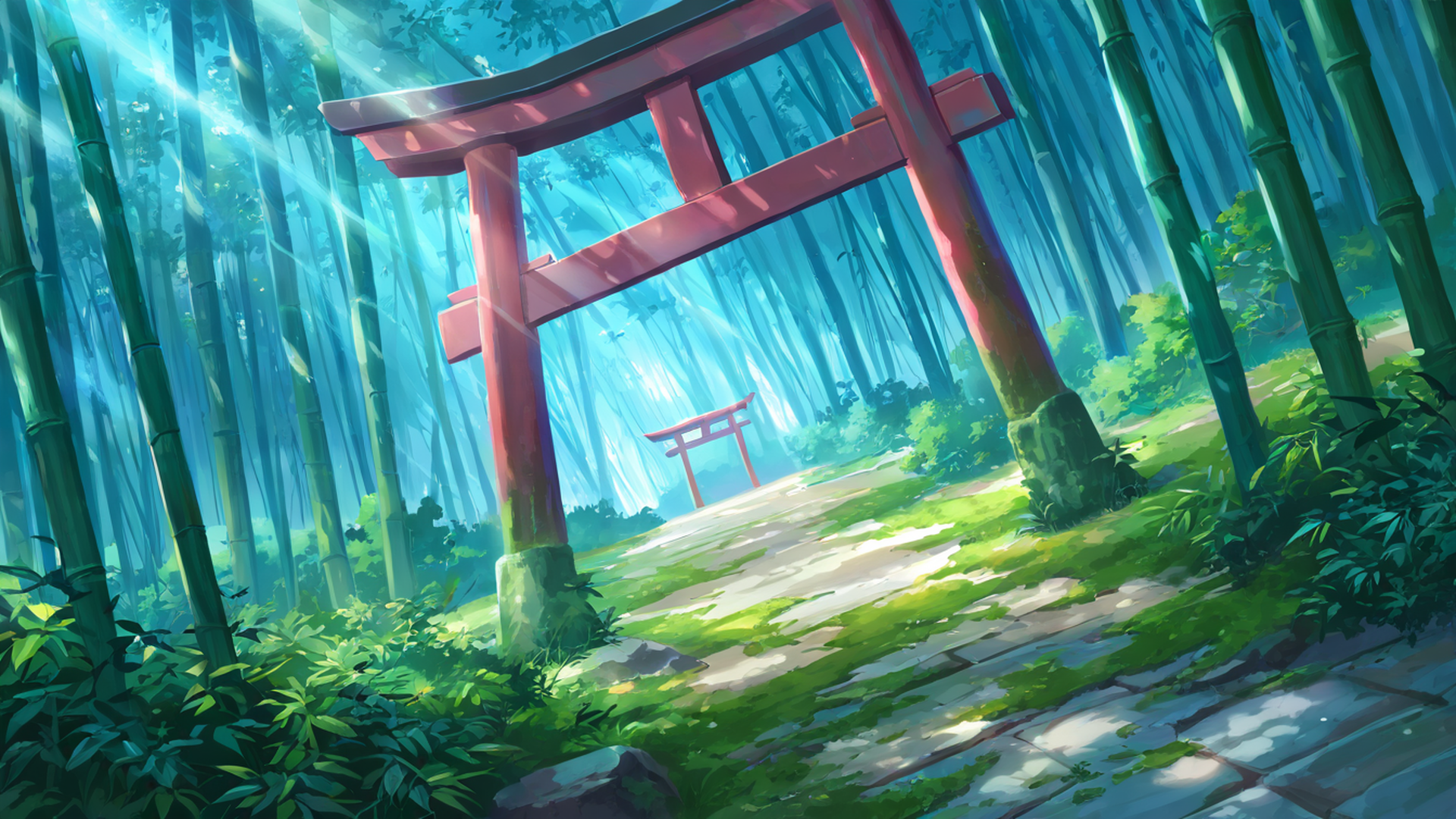
If you want to watch the source material, in roughly the order in which they will repay your attention as a lofi viewer: begin with Whisper of the Heart, the most direct ancestor; then My Neighbor Totoro for the countryside grammar; then Spirited Away for the night register; then Kiki’s Delivery Service for the cozy interiors; then 5 Centimeters Per Second for Shinkai’s contribution. As workspace music in their own right, the Spirited Away, Howl’s Moving Castle and Princess Mononoke soundtracks are all worth living inside for a few weeks each. And if you cannot watch the films right now, our aesthetic wallpaper gallery is built on the same vocabulary — browse autumn maple village or shrine torii to see the Ghibli DNA at work, una composizione at a time.
The bigger picture
Lofi visuals exist because Studio Ghibli, with Shinkai close behind and Watanabe’s Cowboy Bebop a little to one side, spent four decades refining a visual language for quiet contemplative moments. That language was not invented for studying. It was invented for telling stories patiently, frame by frame, in a tradition that did not require the camera to chase resolution. But it adapts to studying with almost no friction, because both registers share an emotional grammar — patient, gentle, observant, alone but content. Every time a lofi visual sits on your screen during a study session, you are benefiting, whether you know it or not, from forty years of work by the most careful animation studio in the world, and from the patience of one composer who refused to write anything bombastic. The work continues into AI-generated imagery and twenty-four-hour streams because the underlying vocabulary is that durable.
Watch a Ghibli film all the way through, and then study with a lofi stream for an afternoon. The connection becomes obvious in a way that no amount of writing about it quite captures. I have been trying to articulate it for twenty-five years, and the films still say it better than I can.