Few foreign words get stretched as far as wabi-sabi. Online it can mean a linen sofa, a cracked mug, an unmade bed or a beige living room. The Japanese ideas behind it are older and more specific than that, and they usually arrive in a bundle: mono no aware, ma, yūgen and the repair craft of kintsugi all get filed under “Japanese aesthetic”.
This guide takes them one at a time: what each term means, where it comes from and what it looks like in practice. The last section is an honest look at lofi visuals, including the wallpapers on this site, and how much of these ideas they actually carry.
One caution first. These words are not parts of a tidy system. They grew up in different centuries and different arts (poetry, tea, theater, painting), they overlap, and every English translation is an approximation that scholars still argue about.
Wabi-sabi: beauty that admits time
Wabi-sabi joins two words that had separate histories. The Stanford Encyclopedia of Philosophy renders wabi as “subdued, austere beauty” and sabi as “rustic patina”. Together they describe a taste for things that are simple, a little rough and visibly marked by time and use. Behind them sits the Buddhist teaching that nothing is permanent.
The aesthetic took shape around tea. In the fifteenth century the tea master Murata Jukō (1423–1502) began replacing the gold, jade and porcelain of the fashionable Chinese-style tea service with plain wooden and clay utensils. About a hundred years later Sen no Rikyū (1522–1591) pushed the idea much further. He had a tile-maker named Chōjirō hand-mold tea bowls for his austere style of tea, the beginning of what became raku ware, and he is remembered for tea rooms with an entrance so low that every guest, whatever their rank, had to bow to get in.
In the West the term spread largely through the designer Leonard Koren’s 1994 book Wabi-Sabi for Artists, Designers, Poets & Philosophers, which summed it up as the beauty of things “imperfect, impermanent, and incomplete”. Other qualities usually listed are asymmetry, roughness, economy, modesty and a preference for natural materials.
What it is not: a synonym for “rustic”, or a reason to stop cleaning. A useful test is to ask what the imperfection is doing. A tea bowl that leans slightly because it was shaped by hand, or a wooden floor worn pale where people have walked for decades, shows its history honestly. Furniture distressed in a factory to look old is closer to a costume.
Kintsugi: a repair you are meant to see
Kintsugi (“golden joinery”) is the craft of mending broken ceramics with urushi, the sap of the lacquer tree, dusted or mixed with powdered gold, silver or platinum. Instead of hiding the break, the repair traces it in metal. The craft became closely tied to the ceramics used in the tea ceremony, and it is often described as wabi-sabi in physical form: the break becomes part of the object’s story rather than the end of it.
Its origin is usually told through a story about the shōgun Ashikaga Yoshimasa. According to the tradition recorded by the Tokyo National Museum, a Chinese celadon bowl he owned cracked, and he sent it to China hoping for a replacement. None could be found, so it came back fastened with metal staples. That bowl survives. Known as Bakōhan, a thirteenth-century piece from the Longquan kilns, it is now in the museum’s collection, still held together by its staples, which reminded someone of a large locust (some scholars read the name as “leech” instead). The idea that this episode pushed Japanese craftsmen to invent a more beautiful method is a popular theory, not documented history, and even the bowl’s link to Yoshimasa has been questioned.
Traditional kintsugi is slow. Each layer of urushi has to cure in a humid cabinet, sometimes for days and sometimes for a couple of weeks. The material also deserves respect: urushi contains urushiol, the same allergenic oil found in poison ivy and poison oak. Some “kintsugi kits” sold online replace urushi with epoxy resin and metallic powder, which is a different material with different rules, so read the label before eating or drinking from anything mended with one.
Mono no aware: the pathos of things
Mono no aware (物の哀れ) is usually translated as “the pathos of things”. It names a gentle, knowing sadness at the fact that beautiful things pass: watching petals fall, or the last warm evening of the year.
You will often read that the scholar Motoori Norinaga (1730–1801) coined the phrase. Not quite. The expression comes from the literature of the Heian period (794–1185), when aware was an exclamation, something like “ah”. What Norinaga did, in the eighteenth century, was move it to the center of literary theory: he argued that a deep sensitivity to mono no aware was the core of The Tale of Genji, and he used being moved by cherry blossoms as an example of what it means to truly “know” it.
The feeling is not despair. Descriptions of the idea stress balance, an emotion that holds beauty and loss at the same time rather than a surge of grief. That is why it fits quiet scenes better than dramatic ones.
Ma: the interval that does the work
Ma (間) means gap, interval or pause. It refers to space that is meaningful rather than leftover: the bare paper around a painted branch, the silence between two notes, the pause before an answer.
The character is a small picture of the idea. It combines “gate” (門) with “sun” (日), but an older form put “moon” (月) inside the gate, which the sinologist Bernhard Karlgren read as moonlight shining through a gap in a door.
One of the best-known examples is in the Tokyo National Museum: Hasegawa Tōhaku’s Pine Trees, a pair of six-panel folding screens painted in ink on paper in the late sixteenth century and designated a National Treasure. Much of the paper is left untouched. The pines appear and fade into what reads as mist, and the empty areas are what make the scene feel cold, damp and deep. Ikebana works on the same principle, treating the space around the flowers as part of the arrangement, and so does the tokonoma, the alcove of a traditional room that holds a single scroll or vase.
Yūgen: what is suggested rather than shown
Yūgen (幽玄) is the hardest of these to pin down. In the Chinese texts it was borrowed from, it meant “dim”, “deep” or “mysterious”. Japanese critics used it for poetry whose meaning is only hinted at, and the court poet Fujiwara no Teika counted it among the orthodox styles of waka. It later became central to Noh theater through the actor and playwright Zeami.
A list often attributed to Zeami gives the flavor: watching the sun sink behind a hill covered in flowers, wandering in a huge forest without thought of return, watching a boat disappear behind distant islands, following wild geese until they are lost among the clouds. Each experience depends on something that is no longer, or not yet, fully visible.
In images, yūgen is mist over mountains, a path that bends out of frame, a lantern that lights a small circle and leaves the rest in shadow. The viewer supplies the rest.
One more word worth knowing: shibui
Shibui first described the astringent taste of an unripe persimmon, and in everyday Japanese it is still the opposite of amai, “sweet”. As an aesthetic term it means a beauty that looks simple at first and rewards a closer look: a matte glaze with subtle variations, a plain cloth with a fine weave. Shibui things are not necessarily imperfect or asymmetrical, which is what separates the idea from wabi-sabi. It is a good word to have when “minimalist” feels too cold.
Where lofi art fits, and where it doesn’t
The classic lofi image (a figure at a desk by a rain-streaked window, a cat, a warm lamp, a city at dusk) borrows from these ideas, but mostly in mood.
Some of the overlap is real:
- Ma: an empty engawa porch, a single cushion, a wide sky over a field.
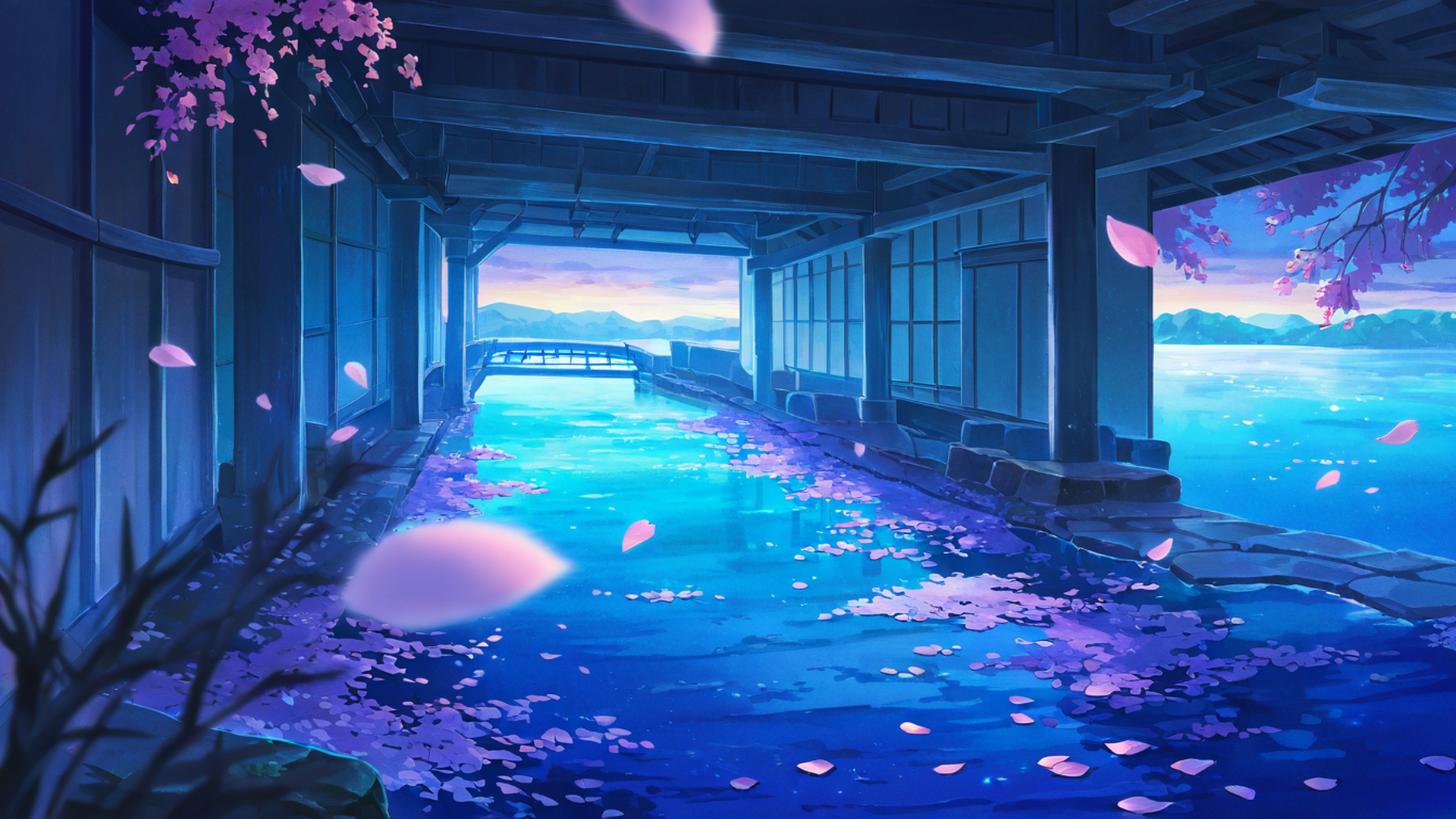
- Mono no aware: dusk, falling petals, the moment just after rain. Lofi loves in-between moments that are about to end.
- Yūgen: mist, a path leading out of frame, a character seen from behind.
- Sabi: worn wood, old shopfronts, rain on stone.
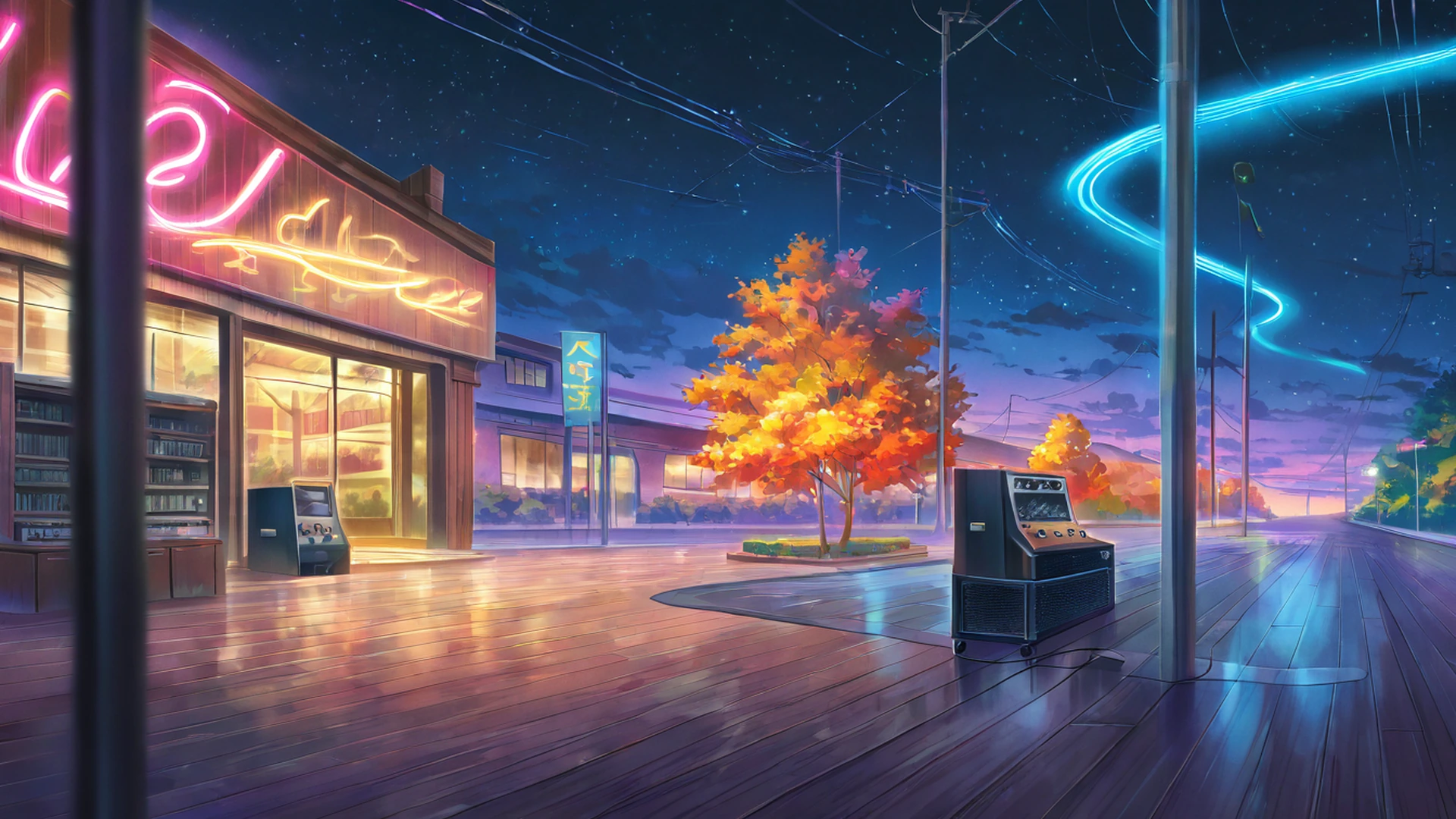
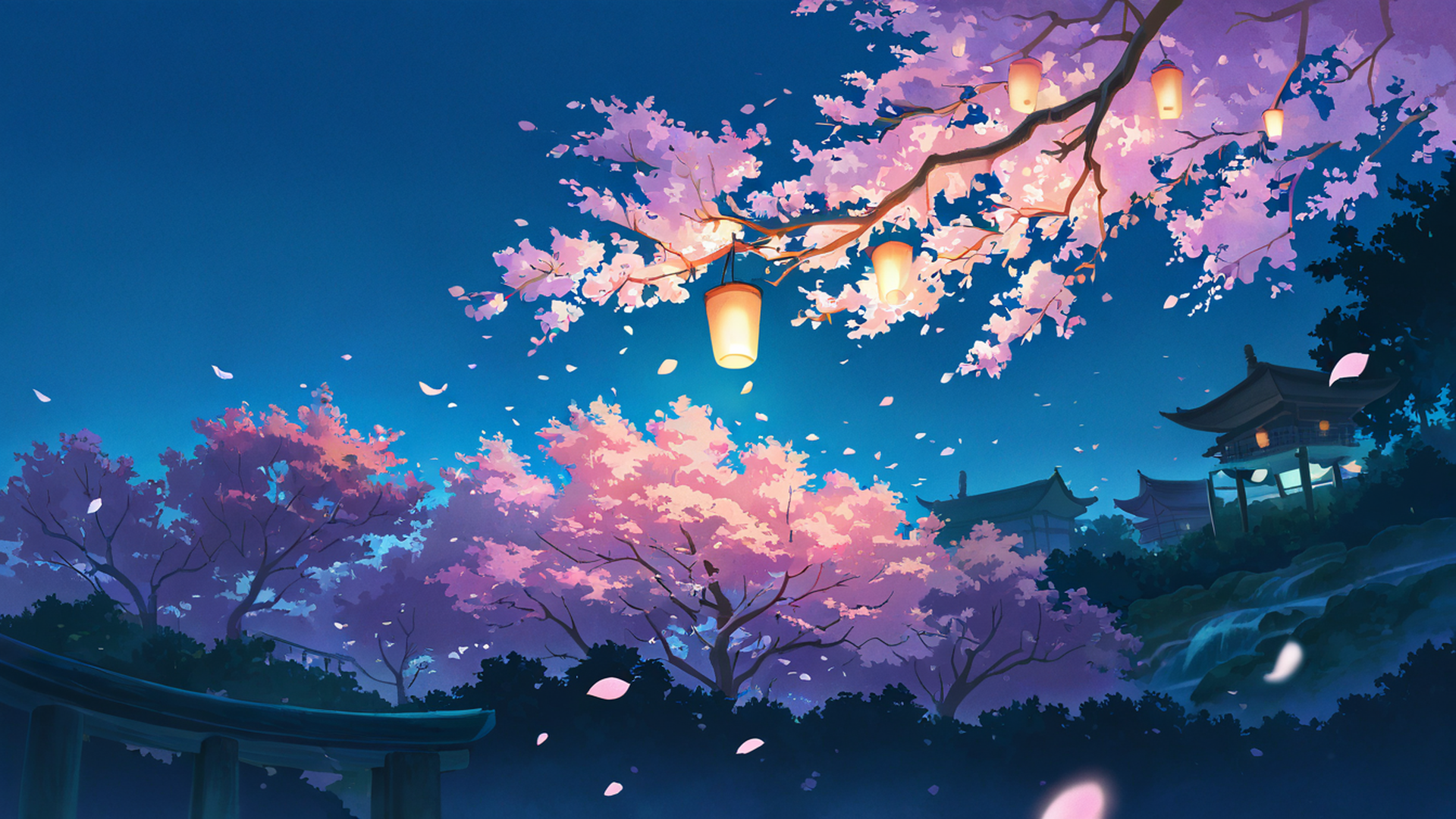
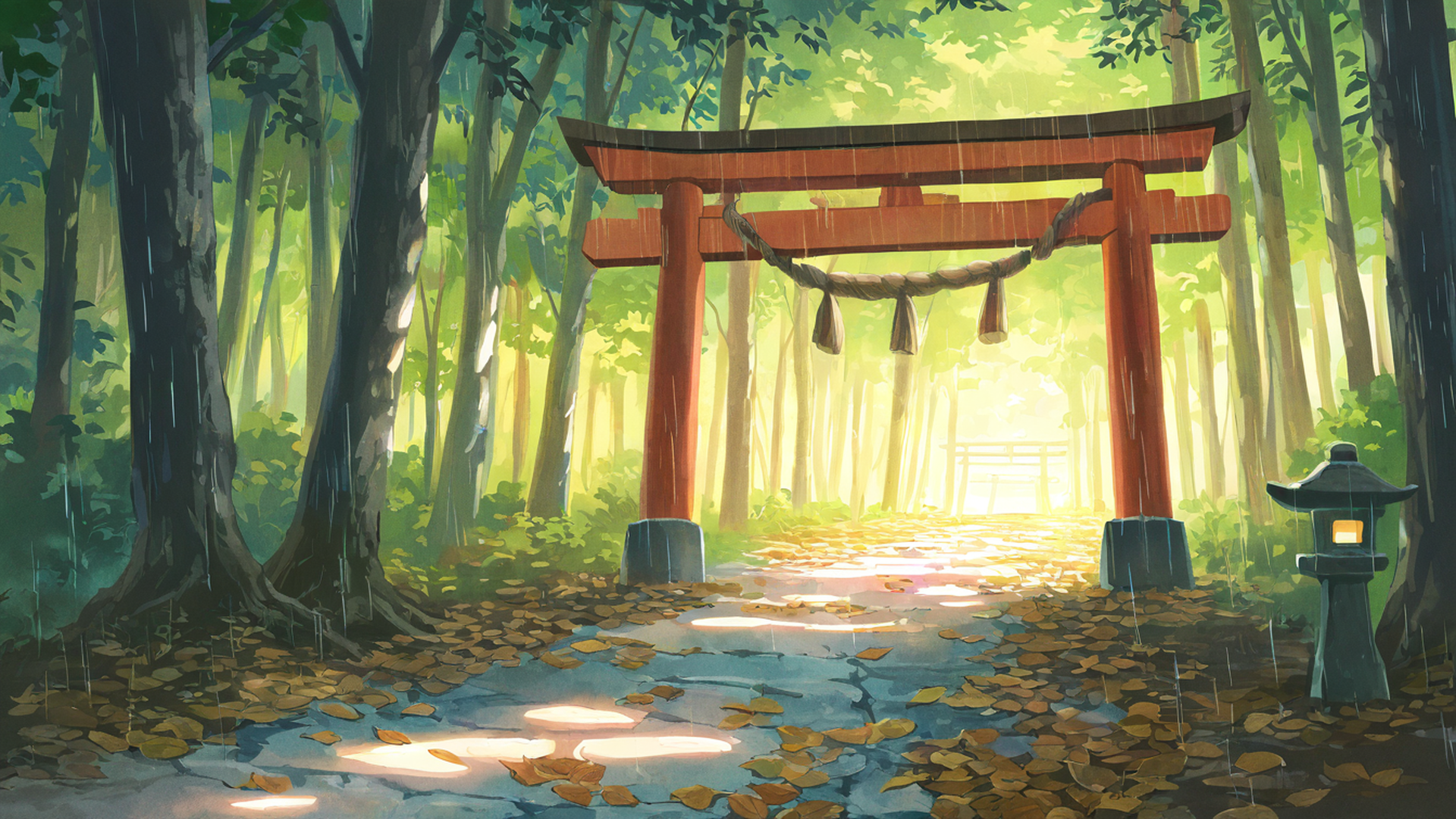
A lot of it pulls the other way. Much lofi art, and especially AI-generated art, is polished, saturated and symmetrical. Sunsets glow, lanterns are spotless, every surface looks new. That is closer to kirei (clean, pretty) than to wabi-sabi. The wallpapers on this site are a fair example. They were generated with an AI image model, and while they use motifs such as torii gates, paper lanterns and engawa porches, calling them wabi-sabi in any strict sense would be a stretch. Borrowing a mood is fine; claiming the philosophy is something else.
If you want a background that leans closer to these ideas, look for:
- Plenty of empty space, especially where your icons or widgets sit.
- One main light source instead of glowing details everywhere.
- A muted palette rather than full-saturation neon.
- Signs of weather and time: rain, snow, mist, worn wood.
- Something partly hidden, like a path that turns or a figure seen from behind.
On this site, the rainy porch, snowy mountain village and stargazing hilltop themes come closest. For the practical side of why simpler images are easier to work in front of, see how to choose a wallpaper that doesn’t distract you. The seasonal side of Japanese design, from the 72 microseasons to haiku season words, is covered in the Japanese seasons in design, and the long story of the cherry blossom as a symbol of impermanence is in cherry blossoms through 1,000 years of Japanese art.
Sources
- Parkes, G., & Loughnane, A. Japanese Aesthetics. Stanford Encyclopedia of Philosophy (first published 2005, substantive revision 2023).
- Koren, L. (1994). Wabi-Sabi for Artists, Designers, Poets & Philosophers. Stone Bridge Press.
- Tokyo National Museum. Tea bowl, celadon, known as Bakōhan (Longquan ware, Southern Song dynasty, 13th century). Collection record, in Japanese.
- Tokyo National Museum. Pine Trees (Shōrin-zu byōbu), Hasegawa Tōhaku (Azuchi–Momoyama period, 16th century, National Treasure). Collection record, in Japanese.
- Wikipedia contributors. Kintsugi, Raku ware, Mono no aware, Ma (negative space) and Japanese aesthetics. Wikipedia, accessed October 2026.