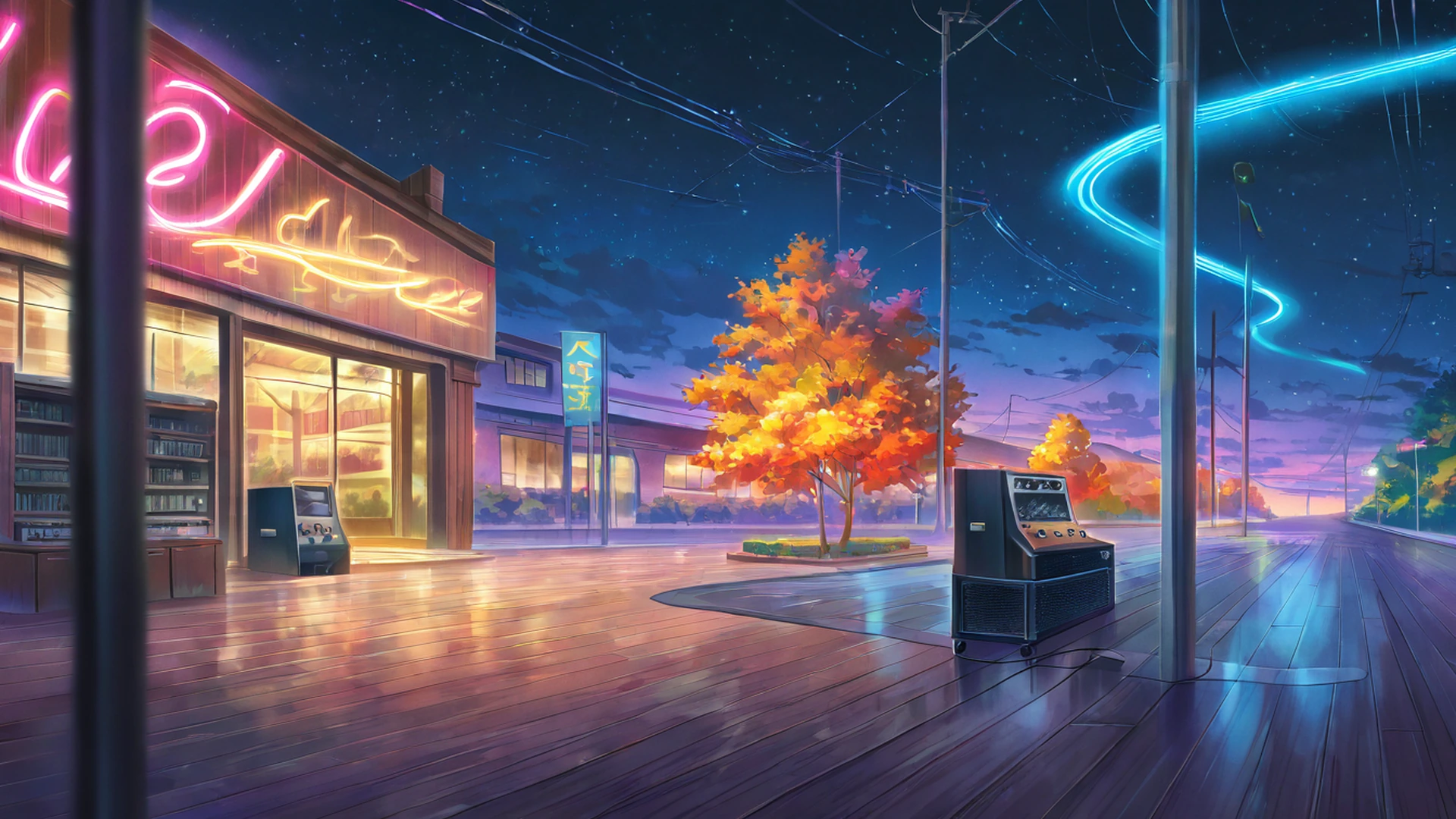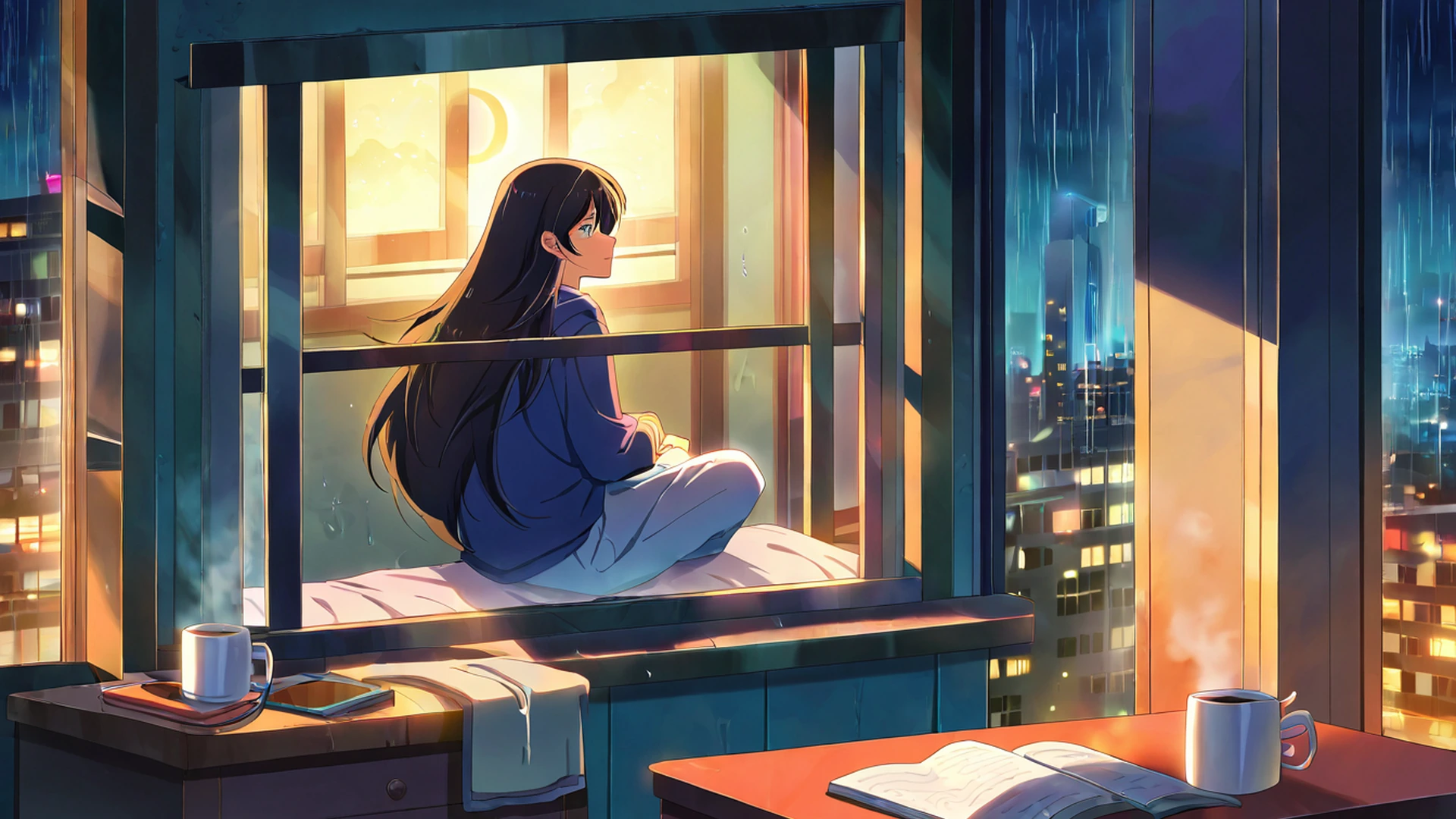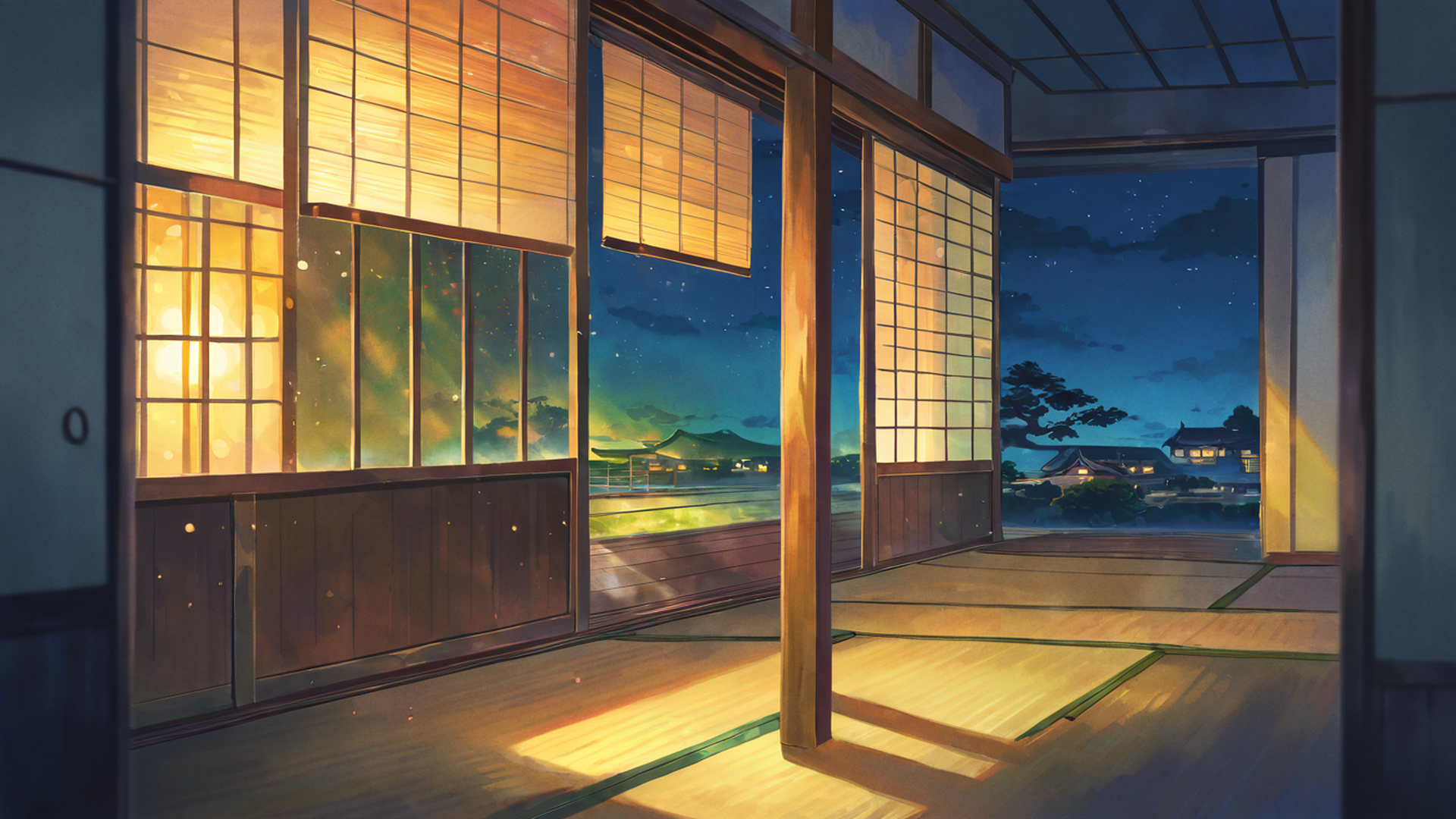
Rain on a window and the murmur of a café are two of the most familiar backdrops in lofi. This guide covers the seven wallpaper themes on this site built around them, what you will actually find in each one, and how to pair them with the rain and café sound loops on the homepage so that the sound helps rather than pulls at your attention.
All of these wallpapers are AI-generated, like everything in the gallery. The descriptions below come from the prompts each theme is built from and from browsing the results.
The rain themes
Rainy Porch Engawa. An engawa is the strip of wooden flooring that runs along the outside of a traditional Japanese house, between the rooms and the garden. These scenes look out from one onto a garden in the rain: shoji doors, moss, stone water basins and dripping maple branches, sometimes with warm light from the rooms inside. There are no people in these scenes. It is the largest rain theme, with 162 landscape images, 40 portrait and 61 ultrawide, and it also has the most animated loops of any theme on the site after Shrine Torii.
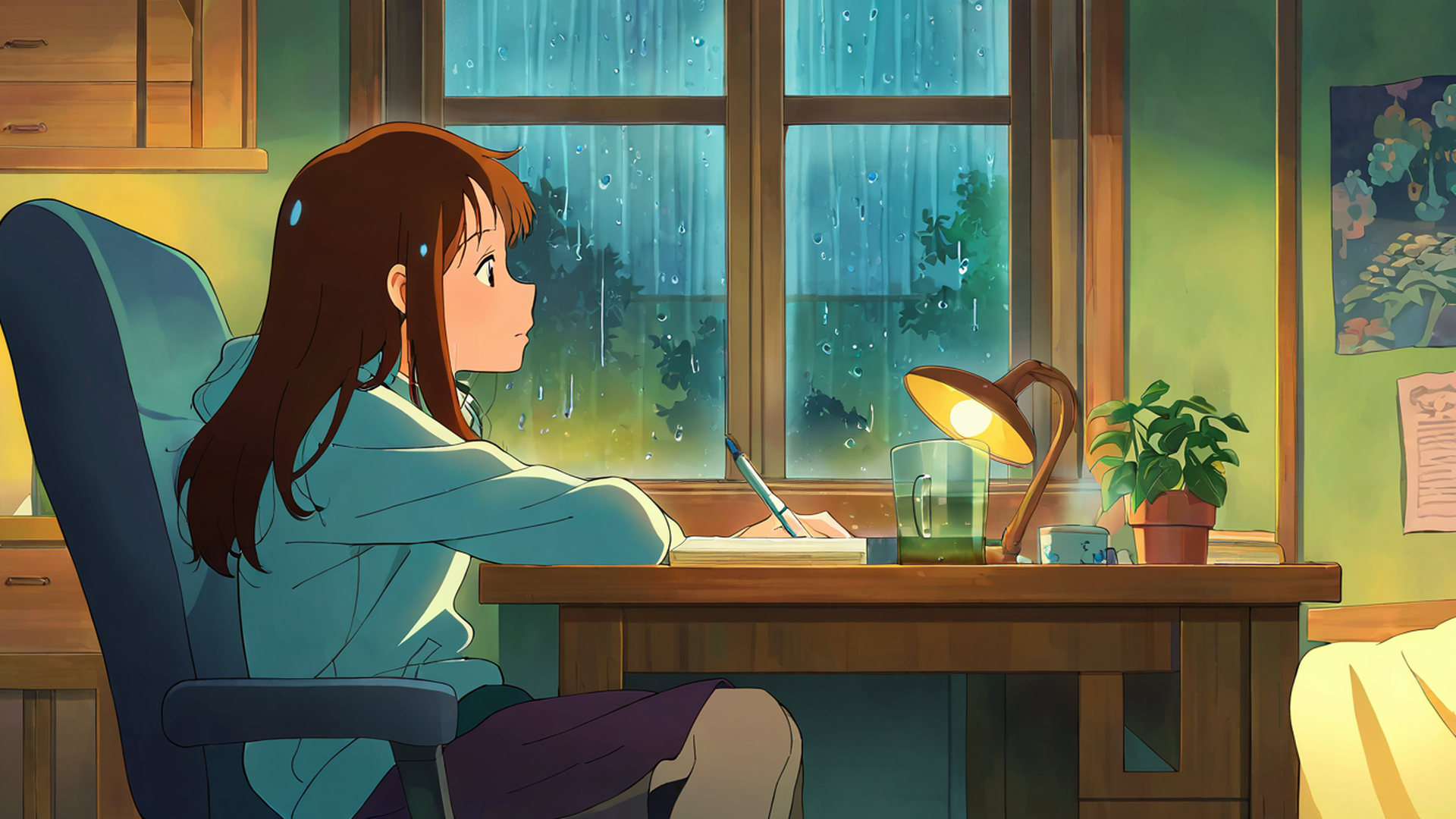
Girl Studying by Rainy Window. A girl at her desk under a warm lamp, rain running down the glass behind her, often with headphones and a mug of tea nearby. This is the classic “study with me” frame: someone in the picture is doing more or less what you are doing. 162 landscape images and 40 portrait.
Old Alley Rain. Narrow wet alleys lit by paper lanterns and glowing vending machines. Some are traditional wooden streets, some lean toward neon, and the occasional cat shelters under an awning. No people. 50 landscape, 40 portrait and 55 ultrawide.
Rainy Bus Stop. A girl waiting alone at a bus stop with an umbrella, puddles and streetlights around her. Several images have dramatic purple skies or a flash of distant lightning, and the figure is usually small in the frame. The moodiest of the set. 50 landscape and 40 portrait.
Cyberpunk Neon Rain. Neon streets in heavy rain, packed with signs and reflections. It is the busiest of the rain themes; the cyberpunk wallpaper guide covers it in more detail. 100 landscape and 40 portrait.
The café themes
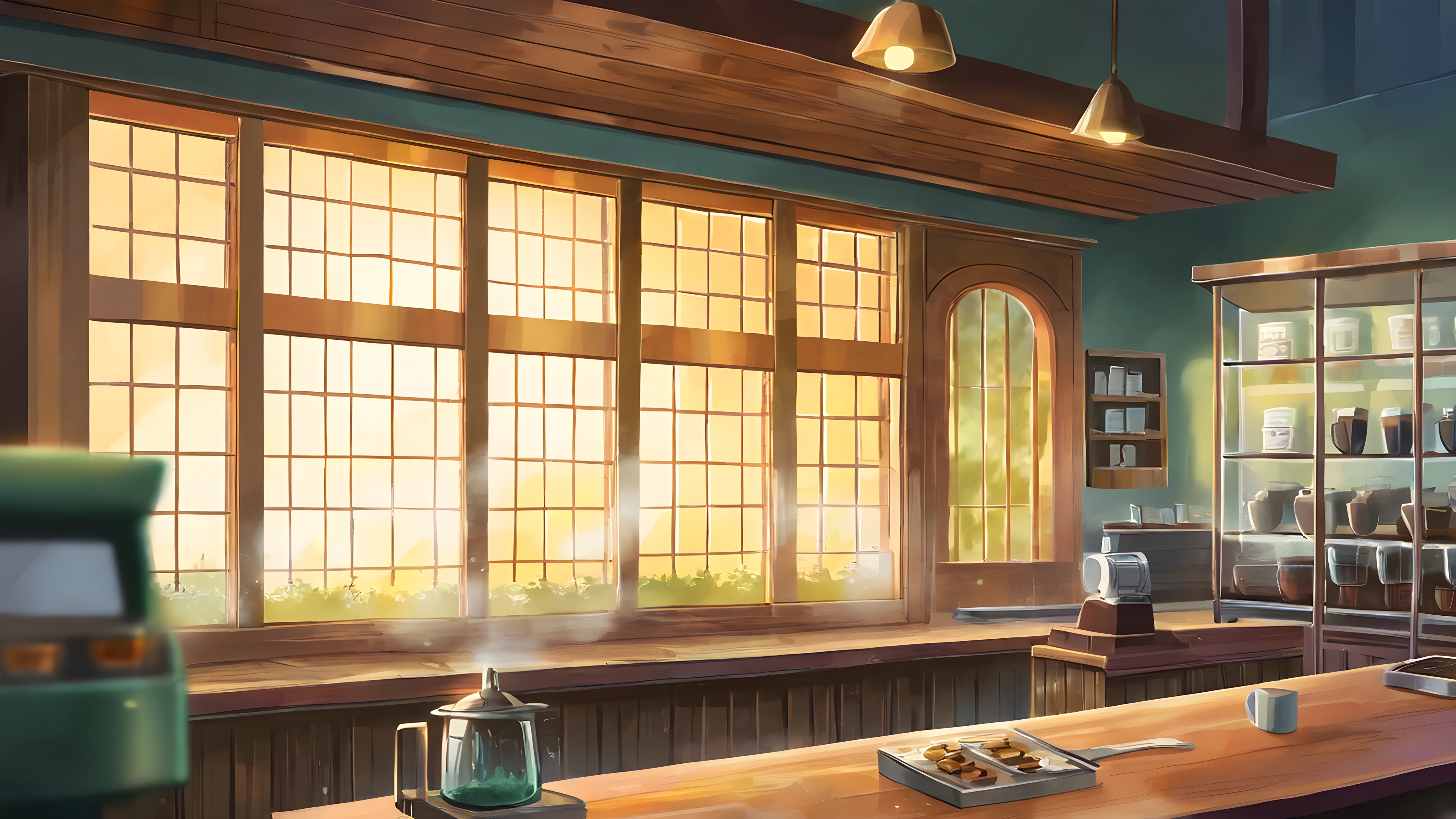
Coffee Shop Morning. Empty café interiors: espresso machines, pour-over setups, shelves of jars, pendant lamps and a lot of warm wood, mostly in morning light. Some follow the look of a kissaten, the traditional Japanese coffee house with dark wood and hand-poured coffee, while others look more like European espresso bars. Some have rain or snow beyond the windows. There are no people. Like any AI collection it has the odd surreal result, such as a pastry or cup at an impossible scale, but most images read as a quiet café before opening. 50 landscape, 50 portrait and 50 ultrawide.
Girl Cafe Japan. A girl with a cup of tea and a book or notebook in a traditional Japanese café, with wooden tables and windows onto a garden. These are brighter, daytime scenes, and some show rain outside. 162 landscape and 40 portrait.
Choosing between them
Empty scenes or company. Rainy Porch Engawa, Old Alley Rain and Coffee Shop Morning have no people. Girl Studying and Girl Cafe Japan put a person in the middle of the frame, and Rainy Bus Stop has a small figure. Some people like the feeling of company; others find a face in the corner of their eye distracting. It is worth trying both.
Dark or bright. The rain scenes are mostly dark and cool, which sits comfortably next to dark-mode apps in the evening. The café scenes are warmer and brighter and suit daytime work.
Detail. For long sessions, quieter images age better. The engawa and coffee shop scenes are calm; the neon rain scenes are not. There is a longer guide on choosing a wallpaper that doesn’t distract you if you want to go deeper.
Pairing the wallpaper with sound
The homepage has the live lofi stream (its volume is set in the YouTube player) and a small mixer with four ambient loops: rain, café, fireplace and wind. Click a loop to turn it on; each has its own volume slider, which starts at 50%, and you can layer several at once.
A simple way to set it up:
- Start the stream at a low, comfortable volume.
- Turn on rain, then lower it until it blends in. It should cover background noise from the room, not compete with the music.
- Add café only if you want it, and keep it below the rain.
It helps to know what the research does and doesn’t say about this kind of sound. In a 2012 paper with five experiments, Ravi Mehta, Rui Zhu and Amar Cheema found that a moderate level of ambient noise, around 70 decibels, improved performance on creative tasks compared with a low level of 50 decibels, while a loud 85 decibels hurt it. Their explanation is that moderate noise makes thinking slightly harder in a way that nudges people toward more abstract processing. Note what they tested: creative tasks, not reading or memorizing.
Speech is a different matter. Hearing words while you try to hold other words in mind is a well-documented distraction, known in memory research as the irrelevant speech effect. A café loop with audible voices may suit brainstorming or sketching better than learning vocabulary; rain contains no speech at all.
That suggests a rough rule of thumb: rain for reading and memorizing, café for creative work, and both kept lower than you think. For more on noise colors and focus, see the guide to brown noise and rain sounds.
A rainy study session in five minutes
- Pick a scene and download the size that matches your screen. The guides to ultrawide and phone wallpapers help if you are unsure which one.
- Set it as your background. On Windows, right-click the file and choose Set as desktop background; on a Mac, Control-click it in Finder and choose Set Desktop Picture.
- Open the homepage, start the stream, turn on the rain loop and bring it down until it sits under the music.
- Start the Pomodoro timer: 25 minutes of focus, a 5-minute break, and a longer 15-minute break after a few rounds.
- Put the portrait version of the same scene on your phone. On iPhone you can link that Lock Screen to a Focus, so it appears whenever you switch into study mode.
Using the same scene on both screens is a small touch, but it turns the setup into a routine you can start without thinking about it.
Phone, ultrawide and animated versions
All seven themes have portrait versions for phones in the portrait collection. Rainy Porch Engawa, Old Alley Rain and Coffee Shop Morning also come in ultrawide format in the ultrawide collection.
For animated versions, Rainy Porch Engawa is the theme to look at: it has more than a hundred short loops. The other rain and café themes have only a handful each. Browse them in the animated collection; the how-to guide explains which apps play video wallpapers on each platform.
Sources
- Mehta, R., Zhu, R., & Cheema, A. (2012). Is noise always bad? Exploring the effects of ambient noise on creative cognition. Journal of Consumer Research, 39(4), 784–799.
- Salamé, P., & Baddeley, A. (1982). Disruption of short-term memory by unattended speech: Implications for the structure of working memory. Journal of Verbal Learning and Verbal Behavior, 21(2), 150–164.