Today a cherry tree in bloom is visual shorthand for Japan. It was not always the favorite. When Japanese aristocrats first started holding parties to admire blossoms, the flower they admired was the plum.
This is the story of how the cherry took its place, and what it has been made to mean along the way: court poetry, a warlord’s extravagant picnic, a cultivar that is really one tree copied millions of times, a wartime symbol of death, and a 1,200-year record of spring that now doubles as climate data.
Before sakura, the plum
In the Nara period (710–794), the Japanese court took much of its culture from China, including the custom of drinking wine and composing poetry beneath flowering plum trees. The plum (ume) had arrived from the continent and carried the prestige of Chinese learning.
You can see the preference in the Man’yōshū, the great poetry anthology of the eighth century. By one widely cited count it contains around 110 poems about plum blossoms and only around 40 about cherries. Its fifth book includes 32 poems written at a plum-viewing banquet held in 730 at the house of the official Ōtomo no Tabito in Dazaifu, in Kyushu. That gathering found a modern afterlife in 2019, when the preface to those poems supplied the name of Japan’s current era, Reiwa.
Cherries were not ignored. Wild mountain cherries had their own place in rural life, where the blossoms were linked to the coming harvest and the rice-planting season, and offerings were made to the spirits believed to live in the trees. But in elite culture, the plum came first.
The Heian court switches flowers
During the Heian period (794–1185) the balance tipped. In the Kokinshū, the first imperial poetry anthology, completed around 905, the same count finds about 70 cherry poems against 18 for the plum. From then on, when classical poets wrote simply hana, “flowers”, they meant cherry blossoms.
The change was literally planted in the palace. The tree to the left of the stairs of the Shishinden, the ceremonial hall of the imperial palace in Kyoto, was originally a plum, placed there when the capital moved to Heian-kyō. When it died in the mid-ninth century, Emperor Ninmyō had a cherry planted in its place. A successor of that tree, known as the Sakon no sakura, still stands there today.
Emperor Saga, earlier in the same century, is credited with holding flower-viewing parties with food and sake under the cherry trees of the court, an origin story for hanami as a festive occasion.
The poetry of the time already treats the blossoms as beautiful precisely because they do not last. Ariwara no Narihira wrote a poem, included in the Kokinshū, that turns the idea inside out:
If in this world there were no cherry blossoms at all, how calm the heart would be in spring.
Ki no Tomonori, one of the anthology’s compilers, asked the question more directly:
On a spring day in such calm, unhurried light, why do the blossoms fall with such restless hearts?
(Both translations here are loose renderings.) The worry, the impatience and the sense of loss are part of the pleasure. That combination is what later writers would call mono no aware, the pathos of things.
The Tale of Genji and the blossom banquet
Murasaki Shikibu’s The Tale of Genji, written in the early eleventh century, is where hanami first appears as a word for cherry blossom viewing. Its eighth chapter, “Hana no En” (“The Festival of the Cherry Blossoms”), is built around a blossom banquet at the Shishinden in the second month of the year. Genji composes poetry in Chinese and dances for the court. Afterwards, wandering through the palace on a night of hazy moonlight, he hears a young woman reciting a poem that says nothing compares to the misty moon of a spring night, neither bright nor fully clouded. The encounter sets off one of the novel’s most consequential affairs.
The blossoms frame the scene rather than dominate it, and that is typical of how the cherry works in Heian literature: it sets the mood, it marks the season, and it reminds the reader that the moment will pass.
Saigyō’s wish
The monk-poet Saigyō (1118–1190) wrote about cherry blossoms so often that they became part of his legend. His best-known poem is a wish about his own death:
If I could choose, I would die in spring beneath the blossoms, around the full moon of the second month.
He died in 1190 at a temple in what is now Osaka Prefecture, and contemporaries were struck that his death had come as he had wished. Poets such as Fujiwara no Teika were moved by it, and the story helped fix the link between cherry blossoms, beauty and mortality in the Japanese imagination.
Norinaga’s mountain cherry
Six centuries later the scholar Motoori Norinaga (1730–1801) made the connection explicit in theory. He put mono no aware at the center of his reading of The Tale of Genji and used the experience of being moved by cherry blossoms as his example of what it means to understand it. He also wrote a short poem that would have a long and troubling afterlife:
If someone asks about the heart of Japan: wild cherry blossoms, glowing in the morning sun.
Norinaga belonged to the kokugaku or “native studies” movement, which tried to read the Japanese classics free of what he called karagokoro, the habits of mind imported from China, and the poem was a statement about native sensibility. In the twentieth century it would be put to a very different use, described further down.
Hideyoshi’s party at Daigo-ji
One of the most lavish hanami ever recorded was held in the spring of 1598 by Toyotomi Hideyoshi, the warlord who had unified Japan. He chose Daigo-ji, a temple in the hills southeast of Kyoto, and visited it repeatedly to oversee the preparations himself. According to accounts of the event, around 700 cherry trees were planted around the temple grounds, eight teahouses were set up for tea and poetry, and about 1,300 guests attended, almost all of them women from the households of Hideyoshi and his lords. The guests were reportedly required to change their clothes twice during the day.
The garden of Daigo-ji’s Sanbō-in, laid out under Hideyoshi that same year, still survives, and the temple is part of the UNESCO World Heritage listing for the historic monuments of ancient Kyoto. Hideyoshi died that September. The Daigo no hanami is remembered as one of the last great displays of his power.
Edo: hanami for everyone
Under the Tokugawa shoguns, flower viewing moved from the court and the warrior class to ordinary city dwellers. The eighth shogun, Tokugawa Yoshimune, had areas planted with cherry trees to encourage it, and hanami in Edo (today’s Tokyo) became what it largely still is: food, drink and noise under the trees.
It was also a golden age for cultivars. Gardeners developed many double-flowered varieties, and books from the period list more than 200 types of cherry. Some of them, like the dense pink ‘Kanzan’, are still planted around the world.
Somei-Yoshino: one tree, copied everywhere
The cherry most people picture today, the pale pink tree that lines rivers and school grounds across Japan, is the Somei-Yoshino. It was raised by gardeners in the village of Somei on the edge of Edo (now part of Toshima, in Tokyo), from a cross between two wild species, the Edo higan and the Oshima cherry. They first sold it as “Yoshino cherry”, after the famous blossom mountain in Nara, and it was renamed Somei-Yoshino in 1900.
Every Somei-Yoshino is a clone of a single original tree, propagated by grafting. It grows fast, flowers before its leaves appear, and spread across the country after the Meiji period began in 1868. Because the trees in a city are genetically identical, they tend to open almost at once, which is part of why the spring “cherry blossom front” can be tracked so neatly as it moves from Okinawa in January to Hokkaido weeks after Tokyo.
The boom had a cost. As cities modernized, many older cultivars were cut down along with the canals and daimyō gardens where they grew. A gardener named Takagi Magoemon and a local village head, Shimizu Kengo, responded by planting a long row of mixed varieties along the embankment of the Arakawa River. That collection went on to supply something famous: the 3,020 trees of twelve varieties that Tokyo shipped to Washington, D.C., in 1912 were grafted from cuttings taken there.
A symbol turned to war
From the late nineteenth century, the Japanese state and military reshaped the cherry blossom into a symbol of soldiers dying young for the emperor. The record is not ambiguous. In 1894, during the First Sino-Japanese War, the poet Sasaki Nobutsuna compared falling blossoms to soldiers falling in battle. In 1930 a secret society of army officers plotting to reorganise the state along militarist lines called itself the Sakurakai, the Cherry Blossom Society. An old proverb, “the best flower is the cherry, the best man is the warrior”, was put to work in the army.
The darkest use came at the end of the Second World War. The first kamikaze special attack force was divided into four units named Shikishima, Yamato, Asahi and Yamazakura, words taken from Norinaga’s poem about wild cherry blossoms in the morning sun. Pilots painted blossoms on their aircraft, and the government encouraged the belief that the souls of fallen soldiers would return as cherry blossoms.
The anthropologist Emiko Ohnuki-Tierney has traced this history in detail in Kamikaze, Cherry Blossoms, and Nationalisms (2002), showing how an aesthetic of fragility was turned into a call to die. It is worth knowing, especially for anyone who uses sakura imagery casually. Since the war the flower has largely returned to its older meanings: spring, beginnings and the brevity of good things. In Japan the school and business year starts in April, so for most people today the blossoms mean new classes and first jobs.
Twelve centuries of spring, now a climate record
Because courtiers and later diarists noted when the cherries bloomed, Kyoto has an unusually long record of a single seasonal event. A court chronicle notes cherry blossoms in 812, and researchers led by Yasuyuki Aono have pieced together full-flowering dates for the city’s wild mountain cherries from old diaries and chronicles, assembling 732 years of data reaching back to the ninth century and using it to reconstruct past spring temperatures.
For most of that time the date was fairly stable. Since the nineteenth century it has moved steadily earlier. In 2021 Kyoto’s cherries reached full bloom on 26 March, the earliest date since the record began in 812. A flower that poets used as a symbol of time passing has become an instrument for measuring it.
Cherry blossom wallpapers on this site
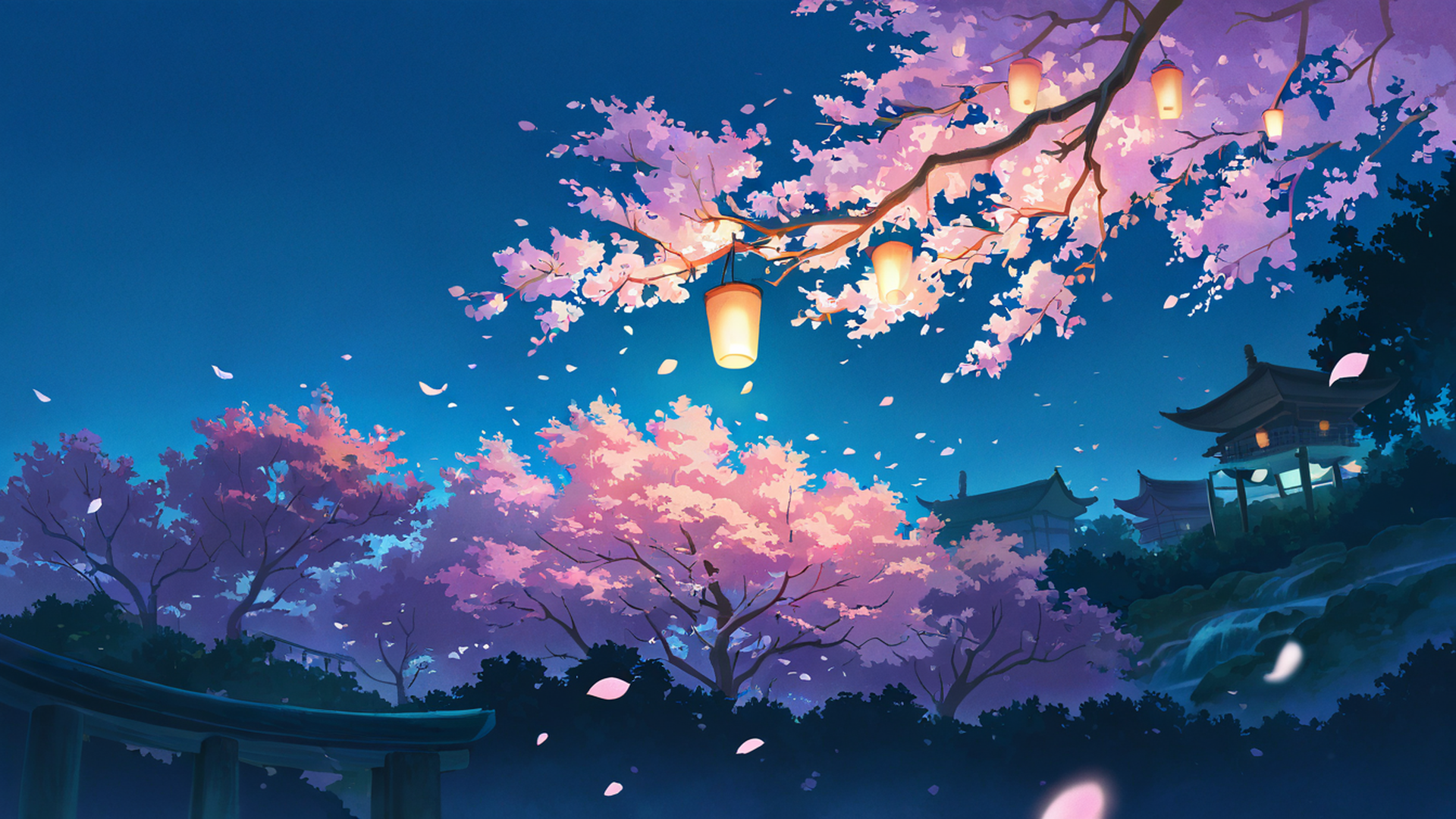
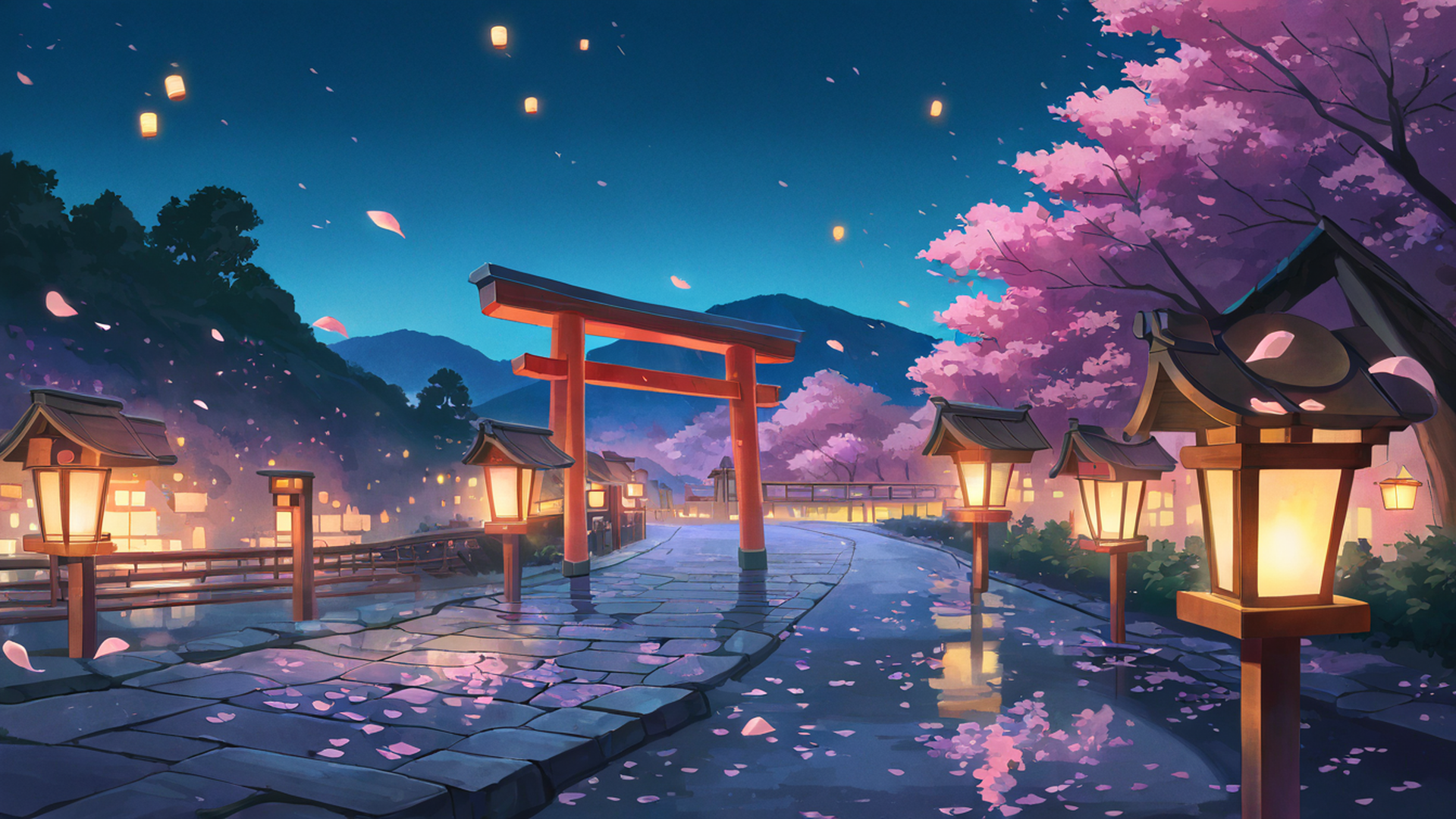
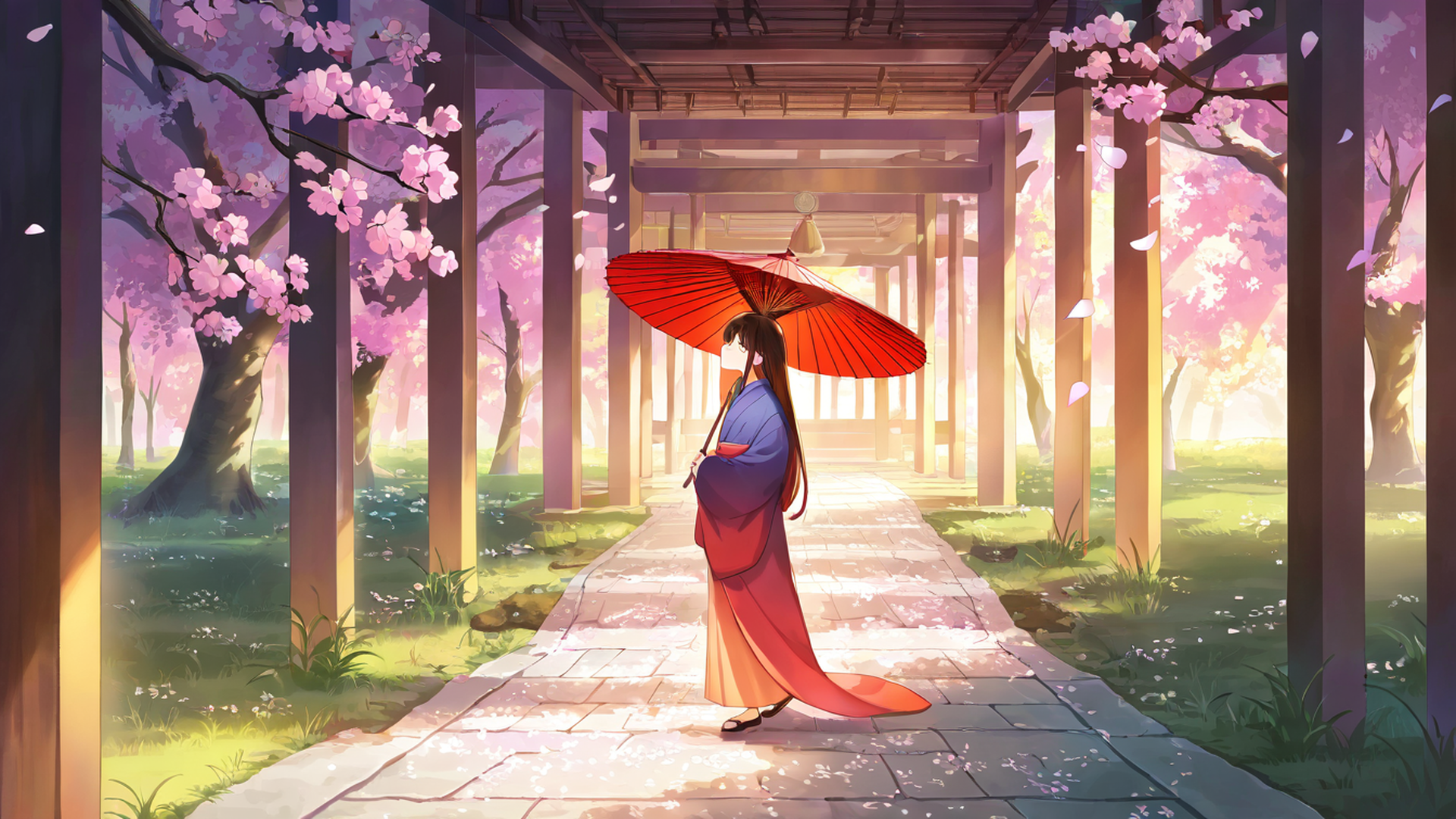
The cherry blossom wallpapers here were generated with an AI image model, so they belong to the long tradition of sakura imagery rather than to Japanese art history itself. Their palette is closer to a bright Edo picnic than to the hushed melancholy of Heian poetry: saturated pinks, glowing lanterns, dusk skies.
Two themes use the motif:
- Cherry blossom path: torii gates, stone lanterns, pagodas and petal-strewn walkways, many of them at dusk or night. The darker scenes work well on a desktop because icons and labels stay readable against the sky and shadows.
- Girl with sakura umbrella: a figure in a kimono with a paper umbrella under the trees, usually seen from the side or from behind. These have a clear subject, so they suit lock screens; there is also a portrait version sized for phones.
If you like to change backgrounds with the time of year, the Japanese seasons in design has a full set of seasonal pairings, and the guide to wabi-sabi and mono no aware goes deeper into the ideas behind the blossoms. Phone-sized versions of every theme are in the portrait collection.
Sources
- Ohnuki-Tierney, E. (2002). Kamikaze, Cherry Blossoms, and Nationalisms: The Militarization of Aesthetics in Japanese History. University of Chicago Press.
- Aono, Y., & Kazui, K. (2008). Phenological data series of cherry tree flowering in Kyoto, Japan, and its application to reconstruction of springtime temperatures since the 9th century. International Journal of Climatology, 28(7), 905–914.
- BBC News (30 March 2021). Japan’s cherry blossom ‘earliest peak since 812’.
- U.S. National Park Service. History of the Cherry Trees.
- Wikipedia contributors. Hanami, Cherry blossom, Prunus × yedoensis, Daigo-ji, Saigyō and Kamikaze; Japanese Wikipedia: 花見, 醍醐の花見 and 左近桜. Accessed October 2026.